When it comes to press brake axis configurations, more axes do not necessarily mean a higher-end machine. What matters most is whether these axes can reduce reliance on manual expertise and minimize process instability when bending complex parts.
For workshops handling parts with simple structures and consistent batch sizes, a 4-axis setup often suffices for most routine needs; however, if you need to produce large quantities of asymmetrical parts, parts with deep flanges, box-type parts, and parts requiring multi-directional positioning, a 6-axis backgauge can significantly increase throughput.
Don’t rush to judge by “the number of axes”; first understand what the number of axes actually affects
Axes truly affect positioning freedom, not the “high-spec impression” on promotional materials
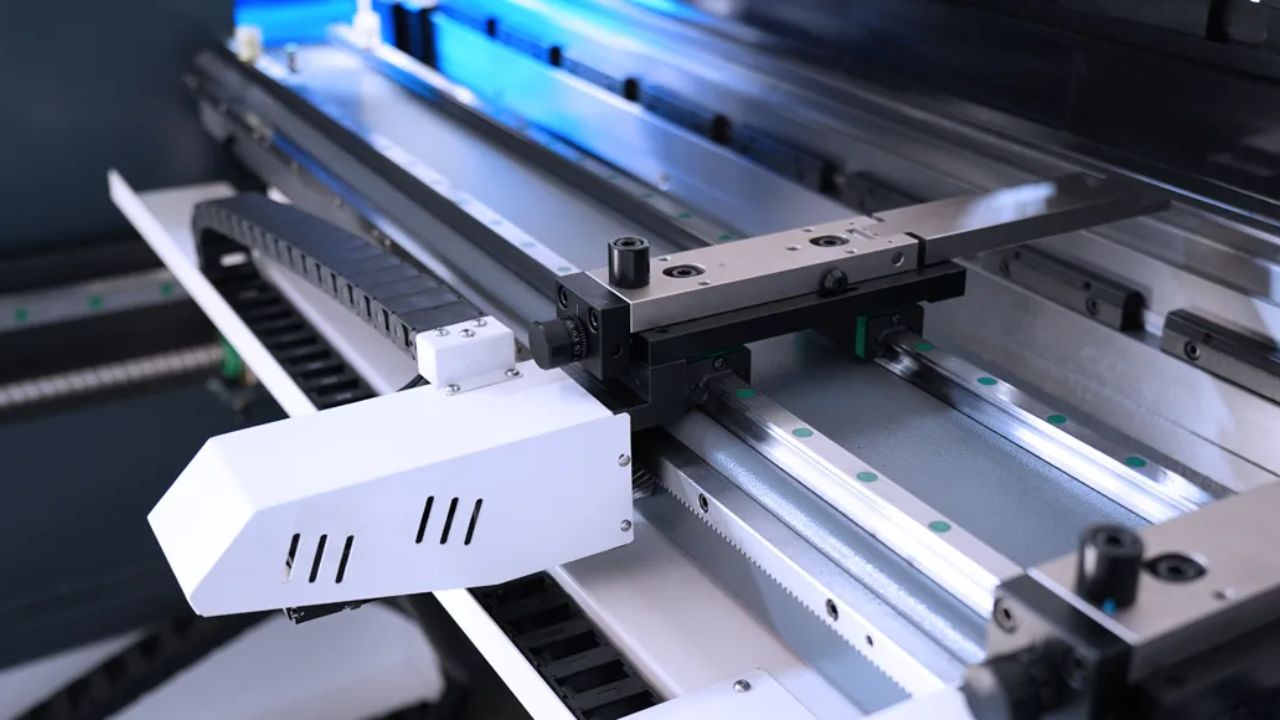
The more axes a backgauge has, the greater its independent movement capabilities. For example, a 4-axis backgauge (typically X, R, Z1, Z2) can move forward/backward, up/down, and left/right, but the two backgauge fingers usually move synchronously in depth and height. In contrast, a 6 axis press brake with a 6-axis backgauge (typically X1/X2, R1/R2, Z1/Z2) allows both backgauge fingers to move independently to different depths and heights, enabling more stable positioning and significantly reducing the risk of manual adjustments.
Why do many factories still rely on manual adjustments even though they have CNC machines?
This is usually not due to an outdated controller, but rather insufficient degrees of freedom in the backgauge. For example, if a backgauge has only two powered axes (X and R), and Z1/Z2 must be adjusted manually, this means the machine cannot perform automatic Z-axis positioning. Consequently, when processing parts with non-parallel edges or parts where the bend line is off-center, manual adjustments are required.
For which types of parts are 4 axes typically sufficient?
Regular parts, single-direction flanged parts, and symmetrical parts
A 4-axis backgauge is generally suitable for standard straight-edge parts, standard L-shaped/U-shaped parts, symmetrical parts, and sheet metal parts with clearly defined gauging edges. Since the positioning of these parts is very stable, a 4-axis backgauge can often support stable and efficient production.
When manual repositioning does not become a bottleneck
If the workshop handles a single product type in large batches, occasional manual repositioning does not necessarily affect production efficiency. This is because what truly determines production efficiency is the repetitive rhythm of the entire batch of workpieces, rather than the flexibility of positioning for individual products.
The value of a 6-axis system lies not in “more,” but in “fewer compromises”
Why complex small parts, box-type parts, and irregularly shaped parts better demonstrate the value of a 6-axis system
Complex small parts, box-type parts, and irregularly shaped parts typically feature varying gauging edges, inconsistent left and right side lengths, and a risk of interference. For these types of parts, the X1/X2 axes of the backgauge can be independently positioned at different depths to complete gauging more quickly; R1 and R2 allow the left and right backgauge fingers to position independently at different heights. This is particularly useful when bending parts with deep flanges, box-type parts, or parts requiring multiple bending operations, as the backgauge fingers can be adjusted independently to more flexibly avoid specific areas of the workpieces, thereby reducing the risk of collision.
What “hidden” on-site issues are best addressed by the 6-axis system?
Issues such as fluctuations in left-right dimensional consistency, unstable positioning when switching sides, the need for manual adjustments despite having a CNC controller, difficulty aligning short flanges, and the need for repeated adjustments for deep flanges can all be addressed with a 6-axis backgauge, thereby reducing reliance on manual expertise.
When does having more than 6 axes become practical?
Heavy plates, large workpieces, modular backgauges, and more complex support scenarios
Having more than 6 axes or adding additional programmable positioning functions offers value not only in scenarios involving heavy plates and large workpieces, but also in the ability to flexibly handle non-parallel edge positioning, asymmetrical parts, and complex reference-changing operations, while supporting production demands requiring higher levels of automation.
Which factories are prone to underutilizing higher-spec configurations?
These are typically divided into the following three categories:
Category 1: Single-part production with stable positioning methods that rarely change;
Category 2: Operational and programming capabilities that cannot keep pace, making it impossible to integrate high-spec features into standard processes;
Category 3: Factories that did not clearly define their specific operating conditions during procurement, assuming that more axes are always better.
What matters more than the “number of axes” is actually your part-family mix
In many manufacturers’ published configurations, a 6-axis backgauge is often regarded as a key threshold for processing complex parts; however, whether it is worth choosing a 6-axis backgauge configuration still depends on your part-family mix.
Don’t focus on a single sample part; consider your long-term part portfolio
When purchasing equipment, you shouldn’t demand a higher-spec configuration based solely on your most complex sample part, nor should you opt for a low-spec machine just because of your simplest part. Instead, assess the proportion of standard parts, asymmetrical parts, box-type parts, parts with deep flanges, and multi-directional positioning parts in your order volume over the next 1–2 years.
The most important question during procurement is not “How many axes at most?” but “Which parts can be produced consistently?”
When procuring, do not merely ask how many axes the backgauge has; instead, confirm: which parts can be produced consistently, whether side changes are required, whether manual adjustments are needed, whether parts with deep flanges can be produced stably, whether repeatable positioning of asymmetrical parts is achievable, and whether consistency can be maintained even after new operators take over.
A checklist for determining axis configuration shared by purchasing and engineering
To determine whether 4 axes or 6 axes are sufficient, consider the following criteria:
Does the part frequently have asymmetrical edges or edges with inconsistent lengths on the left and right sides? If so, 6 axes are generally preferred;
Are small parts, box-type parts, or parts with deep flanges frequently produced? If so, 6 axes are generally preferred;
Do gauging edges frequently change, or is multi-directional positioning often required? If so, a 4-axis backgauge often requires more manual intervention, whereas a 6-axis backgauge offers greater positioning flexibility;
Does the shop floor frequently rely on experienced operators for adjustments? If so, this indicates insufficient freedom of movement for the backgauge, and the choice between 4-axis and 6-axis should be based on actual conditions;
Is high repeatability required? If so, a 6-axis backgauge can repeat the same positioning actions more precisely and consistently;
Is the order structure high-mix, low-volume, or single-variety, high-volume? If the former, a 6-axis backgauge is usually required; if the latter, a 4-axis backgauge is sufficient;
Do you plan to produce more complex parts within the next 1–2 years? If so, choosing a 6-axis backgauge will offer greater value.
Decision Guide: When More Axes Are Worth It
Choosing between a 4-axis and 6-axis press brake should start with the part mix, not the machine brochure. More axes can improve flexibility and reduce setup time, but they only create value when the shop actually needs more complex backgauge movement, higher repeatability, or faster changeover.
A 4-axis configuration may be enough when the shop mainly bends simple brackets, panels, and repeat production parts with straightforward flange positions. A 6-axis configuration becomes more useful when parts have complex geometries, multiple reference points, asymmetric bends, or frequent program changes.
Use these questions before deciding:
- Do operators often reposition parts manually because the backgauge cannot support the next bend accurately?
- Are there many small batches where setup time is more expensive than bending time?
- Do parts require different reference points across the bend sequence?
- Are tight tolerances needed on long or complex parts?
- Will offline programming or automated production be used in the future?
If most answers are yes, a higher-axis configuration may reduce hidden production costs even if the purchase price is higher.
Cost vs. Production Flexibility
The lowest-cost configuration can be the right choice for simple work, but it may limit future jobs. The real comparison should include setup time, operator skill requirements, scrap rate, and the ability to handle new part designs. A 6-axis machine that saves several minutes on every setup can pay for itself in a high-mix shop.
Practical Recommendation
Before buying, review the last 20 to 30 real parts produced by the shop. Mark which parts caused setup difficulty, backgauge limitations, or repeatability issues. This sample gives a more accurate answer than choosing based only on tonnage, bending length, or the number of axes listed in the catalog.